MobileViT Motorcycle Traffic-Violation Detection
Real-time temporal traffic-violation recognition on an embedded ROS2 platform.
Problem
Single-frame detectors miss violations that depend on temporal context — signal changes, sustained crosswalk occupancy — and momentary detection failures turn into false positives. This system defines and detects three violation types under the Road Traffic Act: signal violation, centerline crossing, and crosswalk violation, in real time.
System

System overview — motorcycle dashcam footage flows through YOLO detection and MobileViT temporal analysis on the Jetson board, ending in violation scoring and logging.
- YOLO detects road elements (vehicles, traffic lights, stop lines, crosswalks) and motorcycles.
- ROI sequences of detected objects feed a MobileViT time-series analysis of position and state changes across frames — e.g., whether the stop line is crossed on red, or a crosswalk stays occupied over time.
- When the violation probability exceeds a confidence threshold, the event is logged immediately in JSON and CSV for downstream use.
- Runs in real time on a Jetson Orin NX (RealSense D435i, Ubuntu 22.04 + JetPack 6) with ROS2 Humble.
Validation
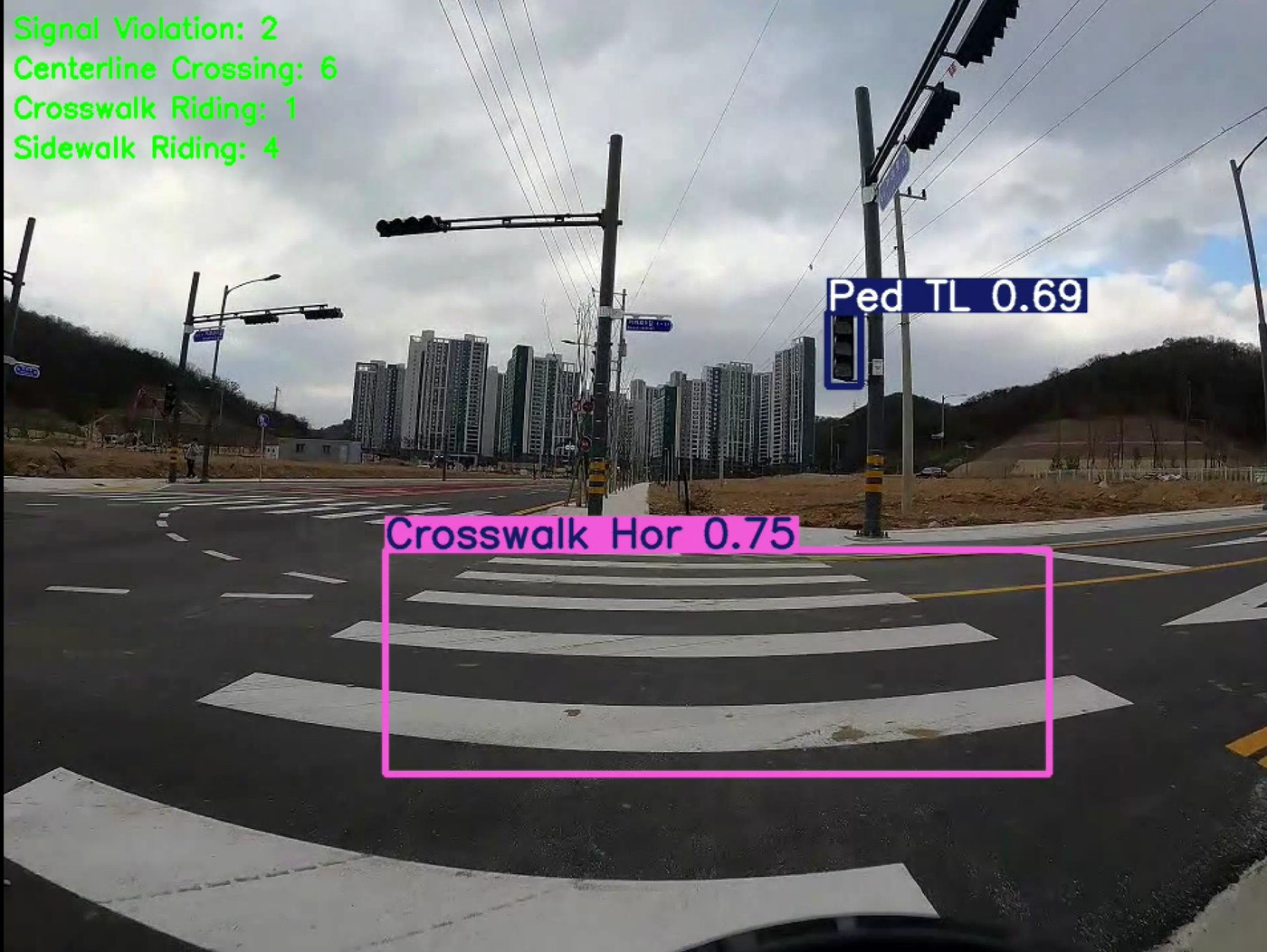
Detection on real driving footage — traffic lights and crosswalks are detected while per-type violation counts are logged in real time.
Evaluated on 75 minutes of real dashcam footage (30 min urban + 45 min rural, day and night), achieving over 90% accuracy across conditions. MobileViT’s temporal analysis compensated for missed detections and filtered transient events to reduce false positives.
This work was part of a motorcycle dashcam-based safe-driving evaluation system under the Gumi Innopolis development program.
MobileViT · YOLO · ROS2 Humble · Jetson Orin NX · RealSense D435i · PyTorch
Publication: Kim, In Gon and Shin, Soo Young, “A MobileViT-Based Detection System for Motorcycle Traffic Violations,” The Journal of Korean Institute of Communications and Information Sciences (JKICS), vol. 50, no. 12, pp. 1822–1829, 2025.